THE RUIN INDEX · TROY · ÇANAKKALE
Troy, nine cities deep
A low mound above the plain of the Dardanelles holds nine cities stacked on top of each other. What you walk past is mostly Bronze Age stone, and none of it needs Homer to impress.
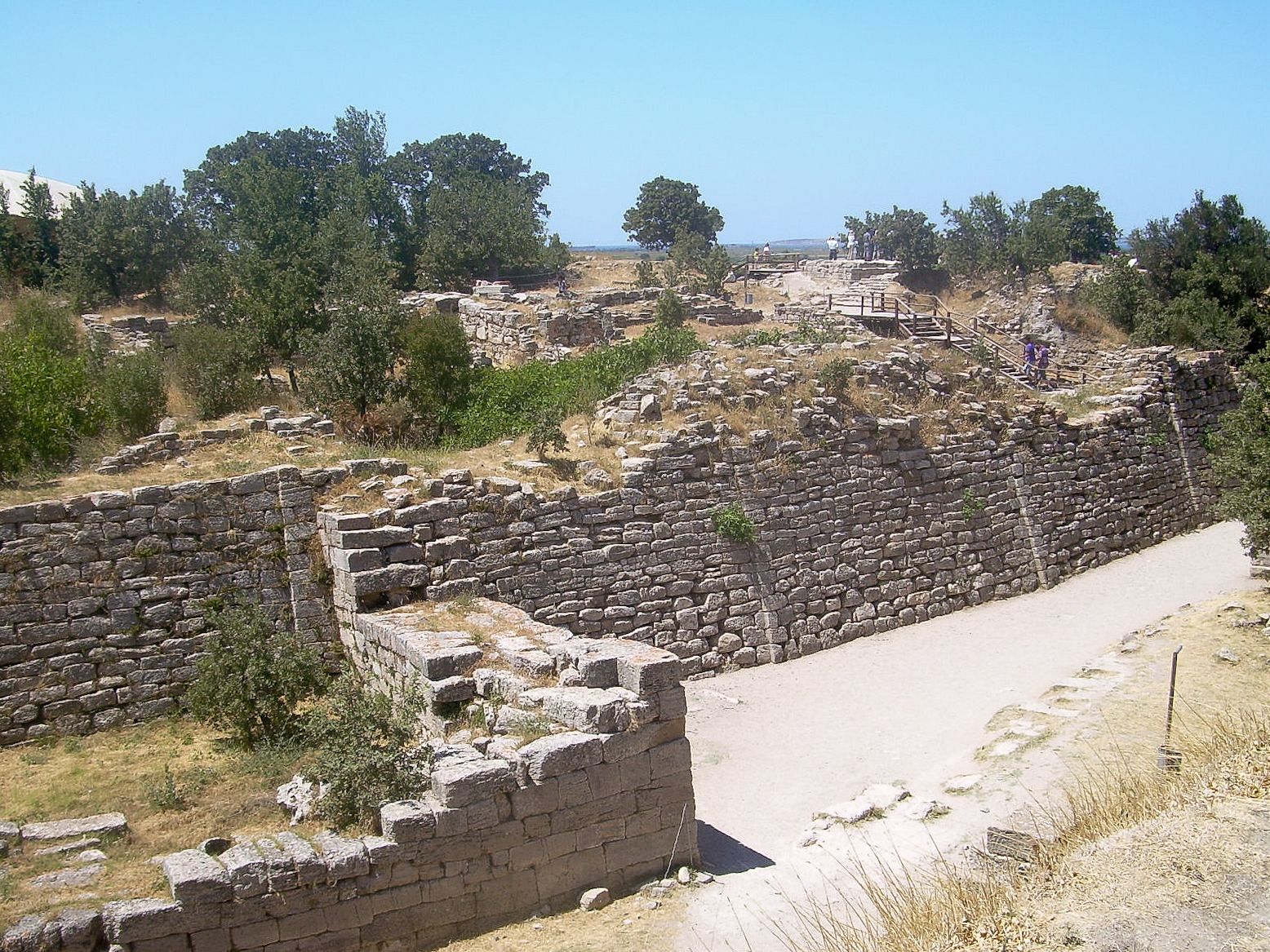
Troy is not a ruined city in the way Ephesus is. There is no marble street to walk down and no grand facade to stand in front of. It is a mound called Hisarlık, about 30 kilometres south of Çanakkale, built up over more than three thousand years by people who kept rebuilding on the remains of the town before. Archaeologists count nine main settlements, the first at the bottom (Troy I) and Roman Ilion at the top, with dozens of smaller phases in between. A visit is a walk through those layers on a signed loop, and once the order clicks, the place becomes one of the most absorbing sites on the coast.
Reading a mound instead of a city
The oldest settlement, Troy I, dates from around 3000 BC. Each later town rose on the levelled ruins of the last, so the mound grew upward and outward. The loop path is numbered, and the boards at each stop are colour-coded by layer. Keep one rule in mind: the deeper the trench, the older the stone. Walls you look down on are usually older than walls at eye level.
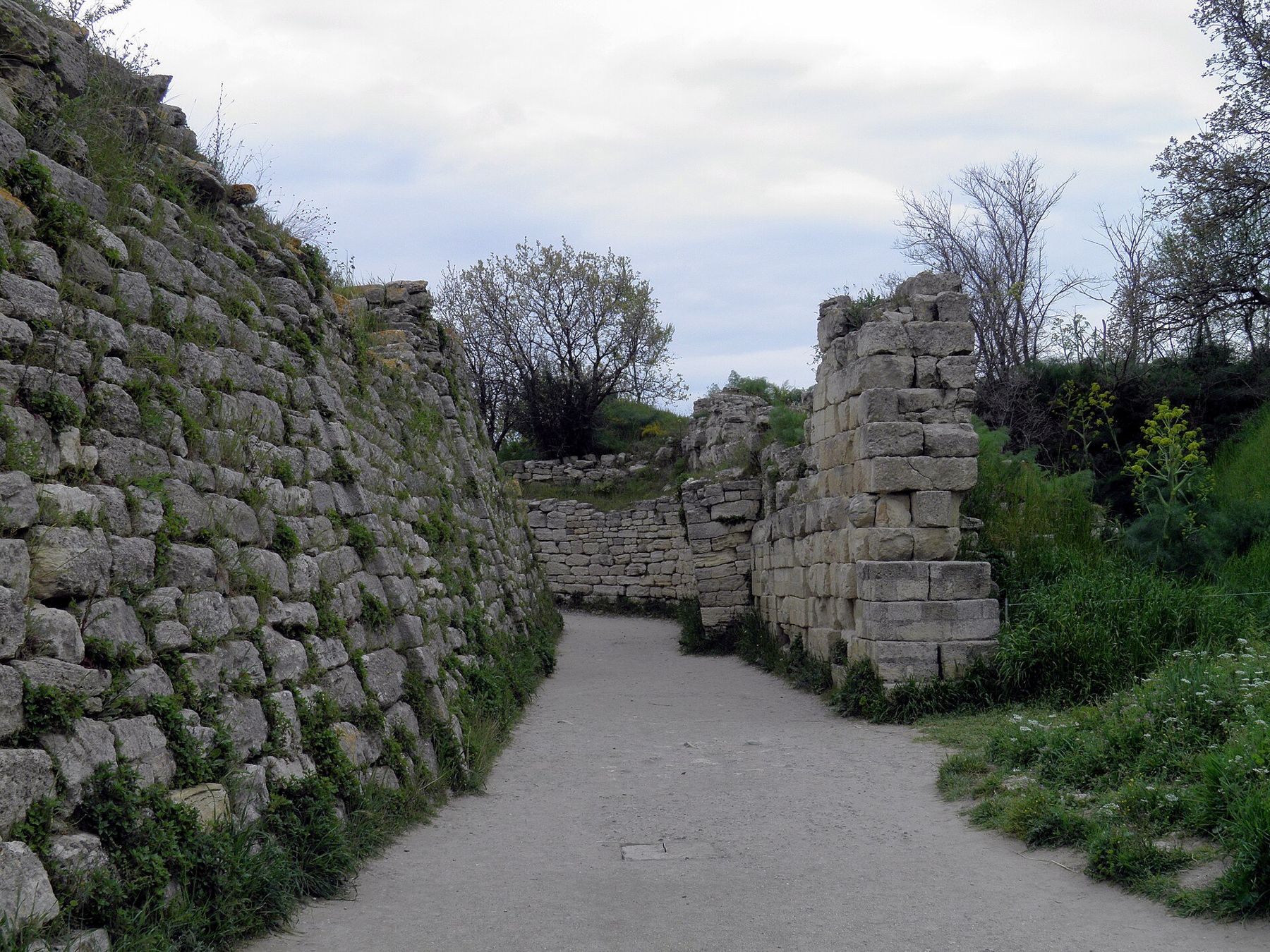
The most impressive masonry belongs to Troy VI, roughly 1700 to 1300 BC. Its fortification walls are built of fitted limestone blocks with a pronounced slope, or batter, and offsets every few metres that throw neat vertical shadows in the afternoon. The east gate and the northeast bastion, a massive tower that once guarded a well, are the places to slow down. Troy VIIa, the town that followed, is the layer most often linked with a destruction around 1180 BC, and so with the story of a war.
Schliemann's trench and what it cost
Heinrich Schliemann began digging here in 1871, convinced that Homer's Troy lay at the bottom of the mound. He cut a great north-south trench straight through the layers, and it is still there, a deep gash that the path crosses. It destroyed a great deal, including parts of the very levels later archaeologists believe date from the time of the legend. It also exposed the stone ramp of Troy II, around 2500 BC, which leads up to a gate and makes one of the clearest sights on the loop.
The gold and silver hoard he called Priam's Treasure came from Troy II, a thousand years older than any Trojan War. It was smuggled out of the Ottoman Empire, later went to Berlin and has been in Moscow since 1945. Later excavators, Wilhelm Dörpfeld, Carl Blegen and then Manfred Korfmann's teams from the 1980s, worked out the sequence of layers that the boards now explain, and showed that the citadel had a large lower town around it.
Walls you look down on are usually older than walls at eye level.
Myth and what is excavated
Whether a war like the one in the Iliad happened here cannot be settled by the stones. What the excavations show is a rich, well-defended town at the mouth of the Dardanelles, destroyed more than once by fire, earthquake or attack, and a later Greek and Roman city that honoured the place as Homer's Troy. Alexander the Great is said to have made offerings here, and the Romans, who traced their own origins to the Trojan Aeneas, rebuilt Ilion with a sanctuary of Athena, a council house and a small odeon whose seats survive near the end of the loop.
2ND C. BCALSO ON THE INDEXPergamon's acropolis and its steep theatre
The large wooden horse by the entrance is a modern photo prop, not a reconstruction of anything. Children love it. Everyone else can walk straight past it to the ticket gate.
The museum by the gate
The Troy Museum stands beside the road at Tevfikiye, a short walk from the site entrance. It opened in 2018 in a rust-coloured building designed to recall the cut through the mound, and it does what the site itself cannot: it puts objects back into their layers. Pottery, gold jewellery returned to Turkey, sarcophagi from the surrounding plain and finds from the nearby burial mounds make the sequence of nine cities concrete. Seeing the museum first, then the mound, works well; so does the reverse if you arrive early to beat the heat.
The minibus out and a morning on the mound
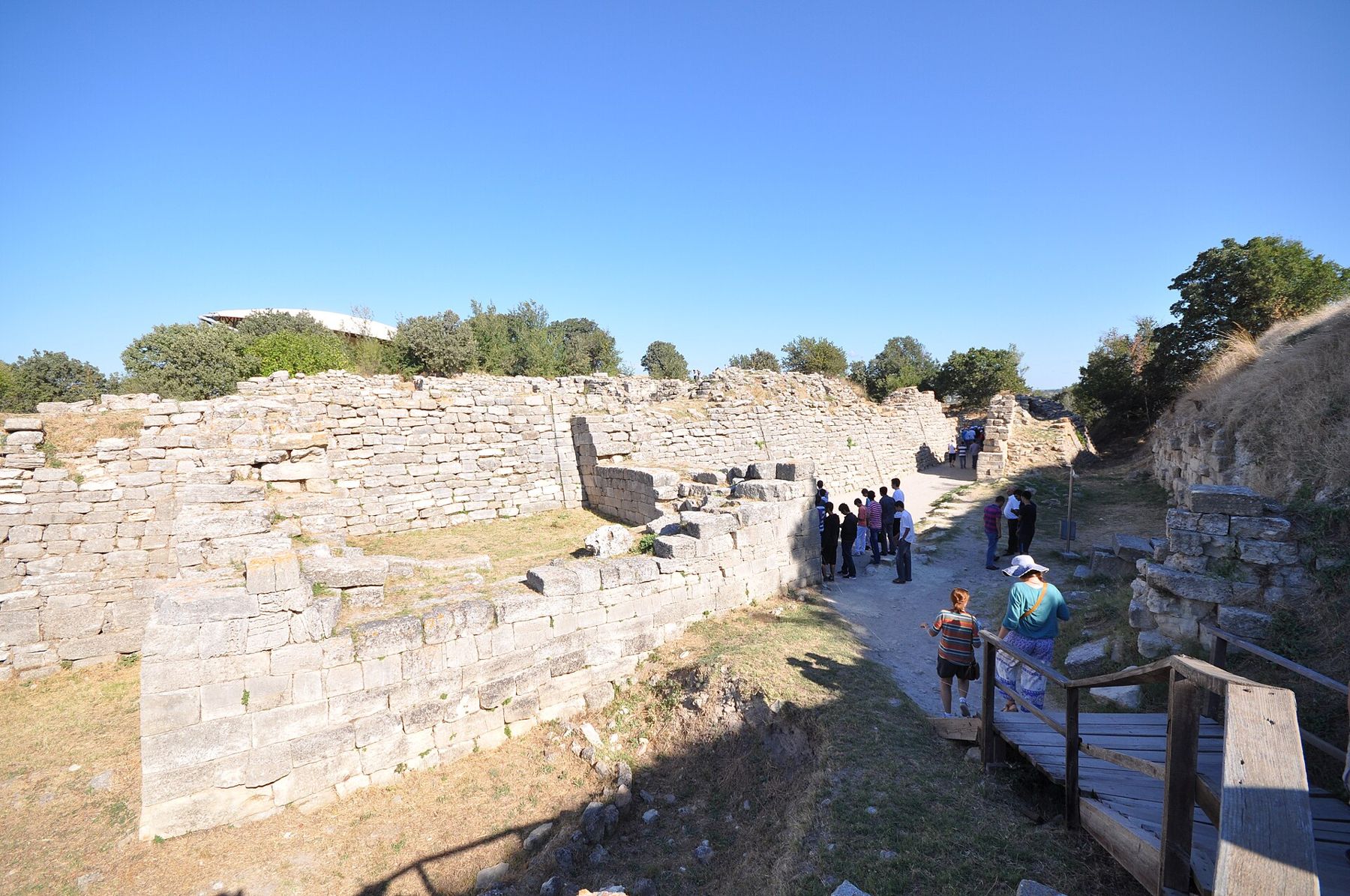
Troy works best as a half-day trip from Çanakkale, the lively town on the Dardanelles where long-distance buses from Istanbul and Izmir arrive. Minibuses to Tevfikiye run from a stop in the town centre near the river, and the ride across the farmland takes about forty minutes. Go early: the mound has almost no shade, and from late morning in summer the light is flat and the heat reflects off the pale stone.
Allow two hours for the loop if you read the boards, and another hour or more for the museum. The path is uneven in places, with steps and some steep sections down into the trenches. Spring brings poppies across the mound and storks on the plain; autumn light is kinder to the walls than August sun.
From the top of the mound, look west and north across the flat farmland. In the Bronze Age, a bay of the sea reached far closer to the citadel, and the Scamander and Simois rivers have since filled it with silt, much as the Maeander did at Miletus far to the south. The low hills dotted around the plain carry burial mounds that later Greeks and Romans identified with Homeric heroes, among them the mound long called the tomb of Achilles. The labels are legend; the mounds are real, and they show how much the landscape mattered to people who came here looking for Homer.
From Çanakkale you can continue south along the coast toward Assos and Ayvalık, or take a bus on to Izmir, where most of the Aegean routes on this site begin. If Troy leaves you curious about how later kingdoms used their hilltops, the theatre on the acropolis at Pergamon is the next great climb south.
A short order for the loop
- Start at the Troy VI east wall and gate, the most complete masonry on the site.
- Follow the path up onto the mound for the view over the plain toward the Dardanelles.
- Stop at the Troy II ramp, then look down into Schliemann's trench.
- Finish at the Roman sanctuary and odeon near the exit.
Take the plan from the entrance or photograph the board at the start. The numbered stops make far more sense in order than at random, and the story of the mound is, above all, a story of sequence.