THE RUIN INDEX · DIDYMA · NEAR DIDIM
The Temple of Apollo at Didyma, never finished
One of the largest temples of the Greek world was begun around 300 BC and was still unfinished centuries later. Its smooth columns and the builders' drawings on its walls make it unlike any other ruin here.
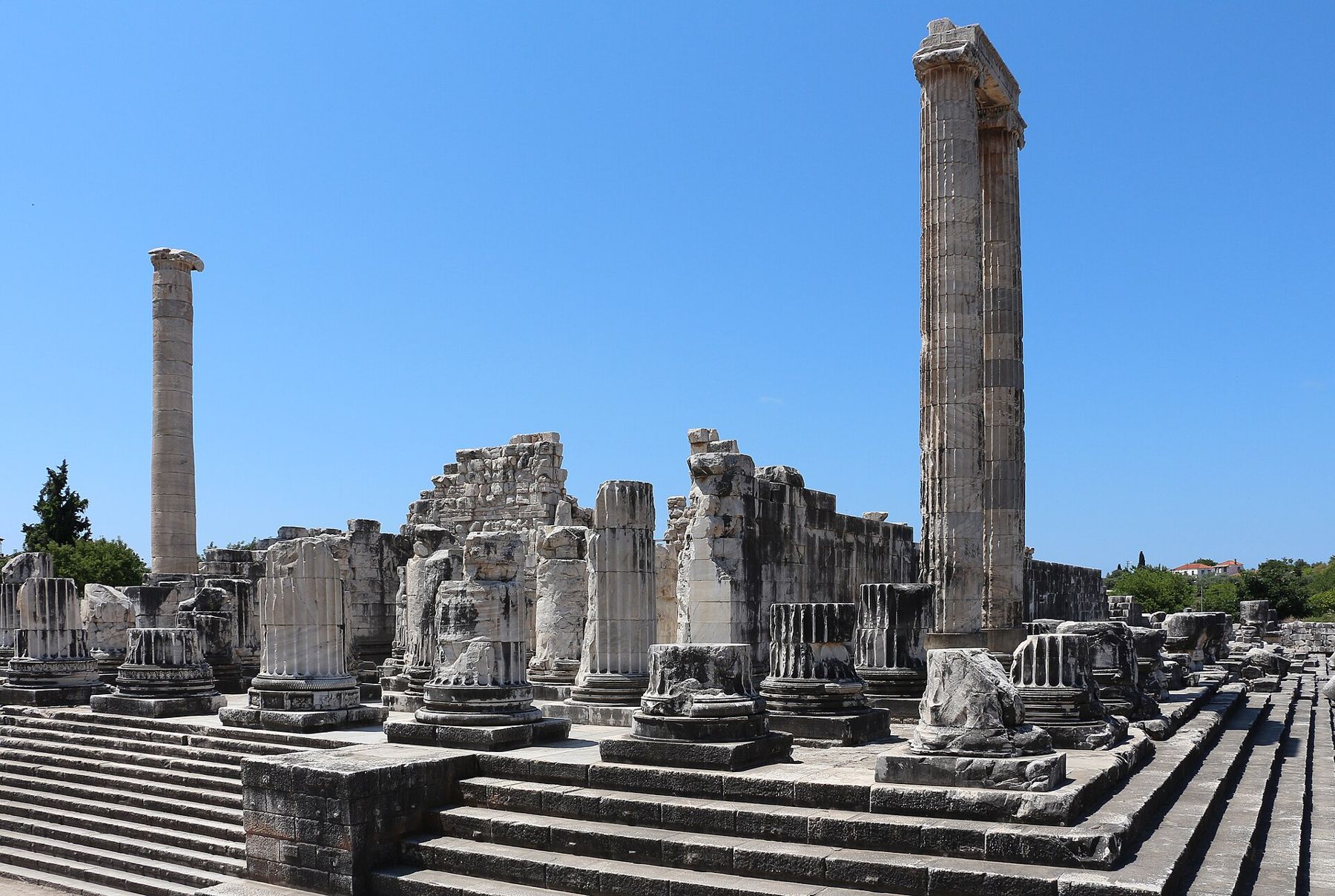
Didyma was never a city. It was a sanctuary of Apollo, home to one of the most famous oracles of the ancient world, and it belonged to Miletus, which lay about twenty kilometres to the north along a sacred road. Today the temple stands in the middle of Didim, a busy holiday town in Aydın province, surrounded by houses and cafés. It is a strange setting for such an enormous building, but once you are inside the low walls of the site, the scale takes over.
An oracle older than the temple
People consulted Apollo at Didyma long before the present temple was built. An earlier archaic temple, served by a priestly family called the Branchidae, was destroyed after the Persians crushed Miletus in 494 BC, and the oracle fell silent. When Alexander the Great freed the coast from Persian rule, the spring was said to have flowed again, and the oracle revived. Around 300 BC work began on a new temple on a colossal scale, with help from the Seleucid kings who succeeded Alexander in Asia.
The oracle was consulted for centuries. Its answers, given through a prophetess and written down by priests, were sought by cities as well as individuals. It finally lost its role when Christianity became the religion of the empire.
Ancient writers name the architects of the new temple as Paeonius of Ephesus and Daphnis of Miletus. The plan they followed was deliberately grand, a statement of what a sanctuary of Apollo could be at a time when the Greek cities of Asia had money and new kings to impress. How the oracle worked in detail is less certain. The prophetess is said to have bathed her feet or drunk from the sacred spring before speaking, and the priests turned her words into verse. Inscriptions record questions and answers from cities and private people, about everything from building projects to the right gods to honour.
A temple that ran out of time
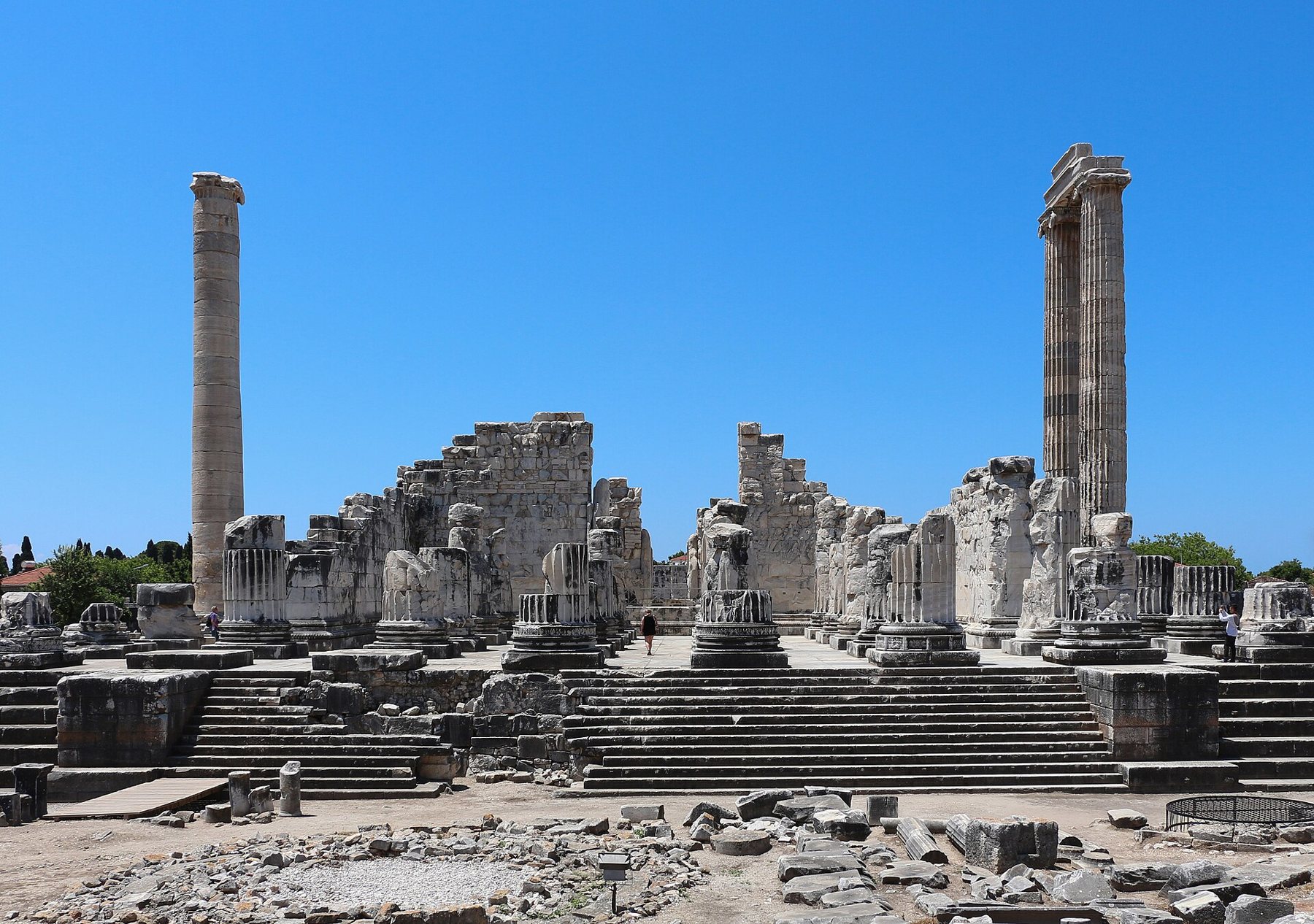
The temple was planned as a huge double ring of Ionic columns around a central building, well over a hundred columns in all, each nearly twenty metres high. Work went on, slowly and in stages, through the Hellenistic period and well into Roman times, and it never finished. Walk around the outer colonnade and you can see the evidence. Some column shafts are smooth, never given their fluting, while their neighbours are finished. A few bases are elaborately carved, each with a different design, and others are plain.
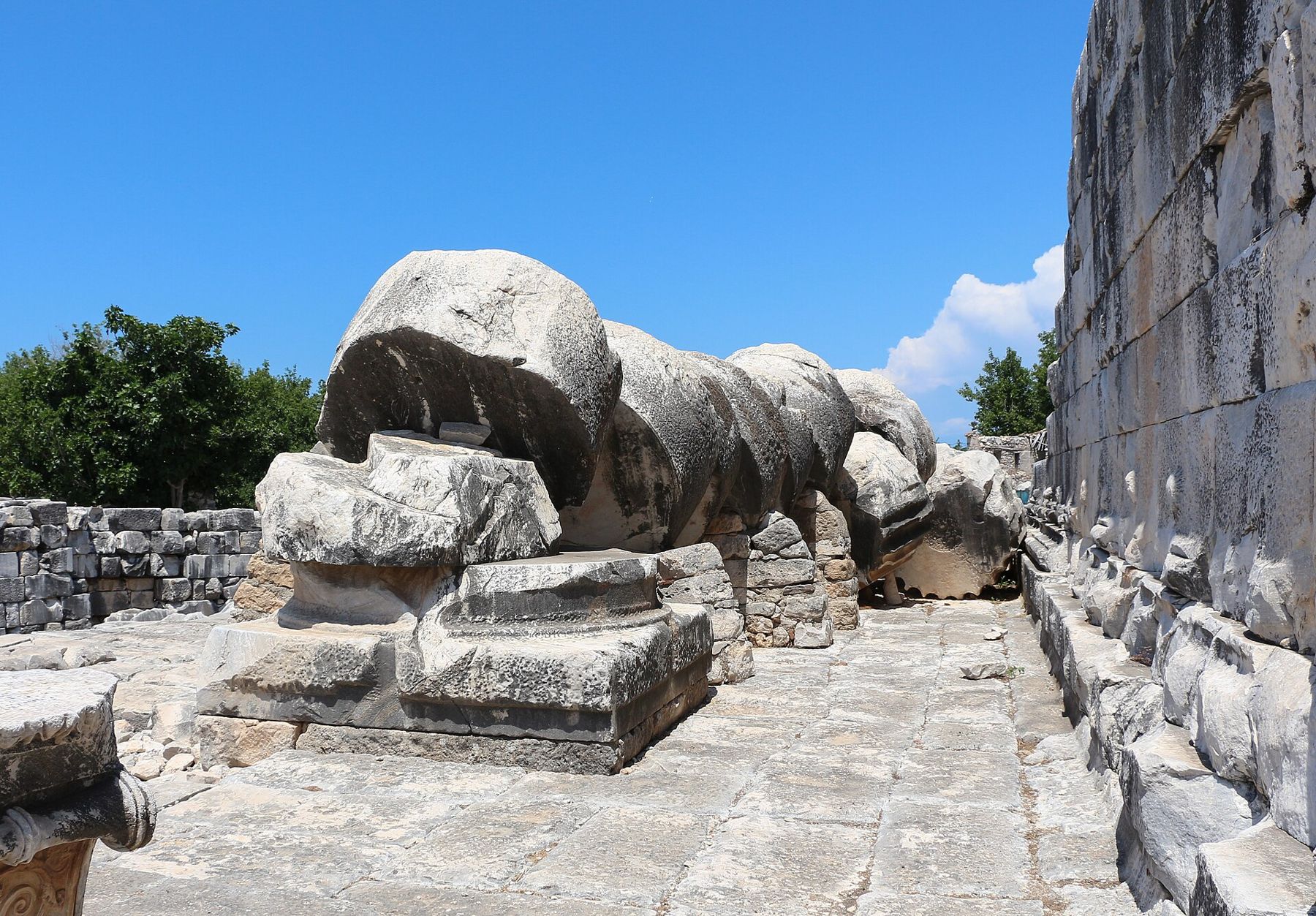
Look at the great staircase on the east front, with its many high steps, and at the porch behind it, where a forest of columns once stood twelve across. The bases there are carved with different designs, from palmettes and meanders to sea creatures, as though each was a showpiece in its own right. The sheer size of the drums lying on the ground helps you picture the height: each column was nearly twenty metres tall.
Today three columns stand at full height, two of them still joined by part of their entablature, and the stumps of the rest rise from the platform like a forest cut down. Earthquakes, especially a severe one in the late Middle Ages, brought most of the building down.
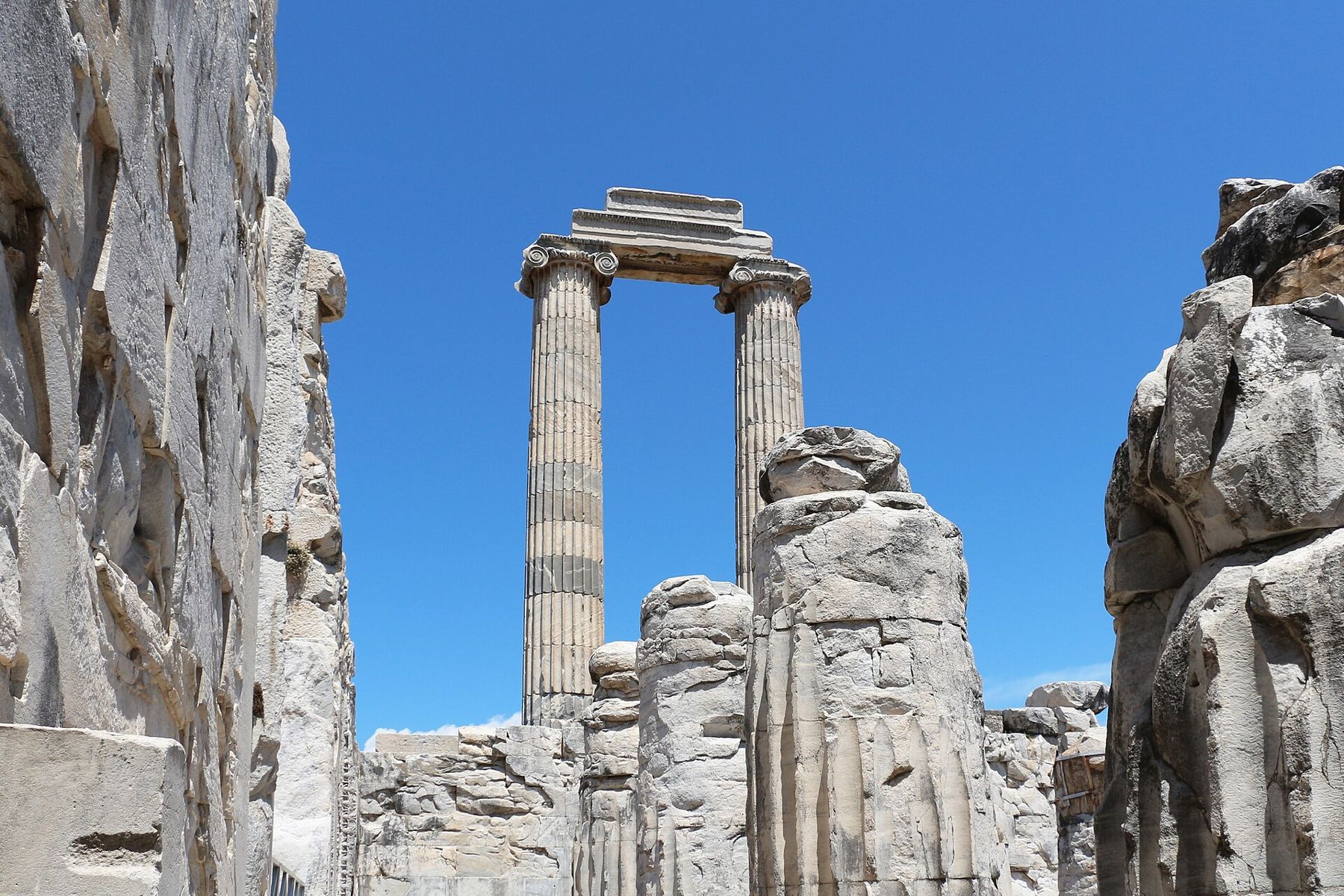
Some column shafts are smooth, never given their fluting, while their neighbours are finished.
Down into the inner court
The most unusual part of the temple is its heart. Instead of a roofed hall, the centre was an open courtyard, the adyton, sunk lower than the porch in front of it and open to the sky. In it stood a small shrine for the cult statue, a sacred spring and laurel trees. Visitors did not walk straight in. Two narrow vaulted tunnels slope down from the porch into the court, and walking through them still has a theatrical effect as you come out into the light between the high walls.
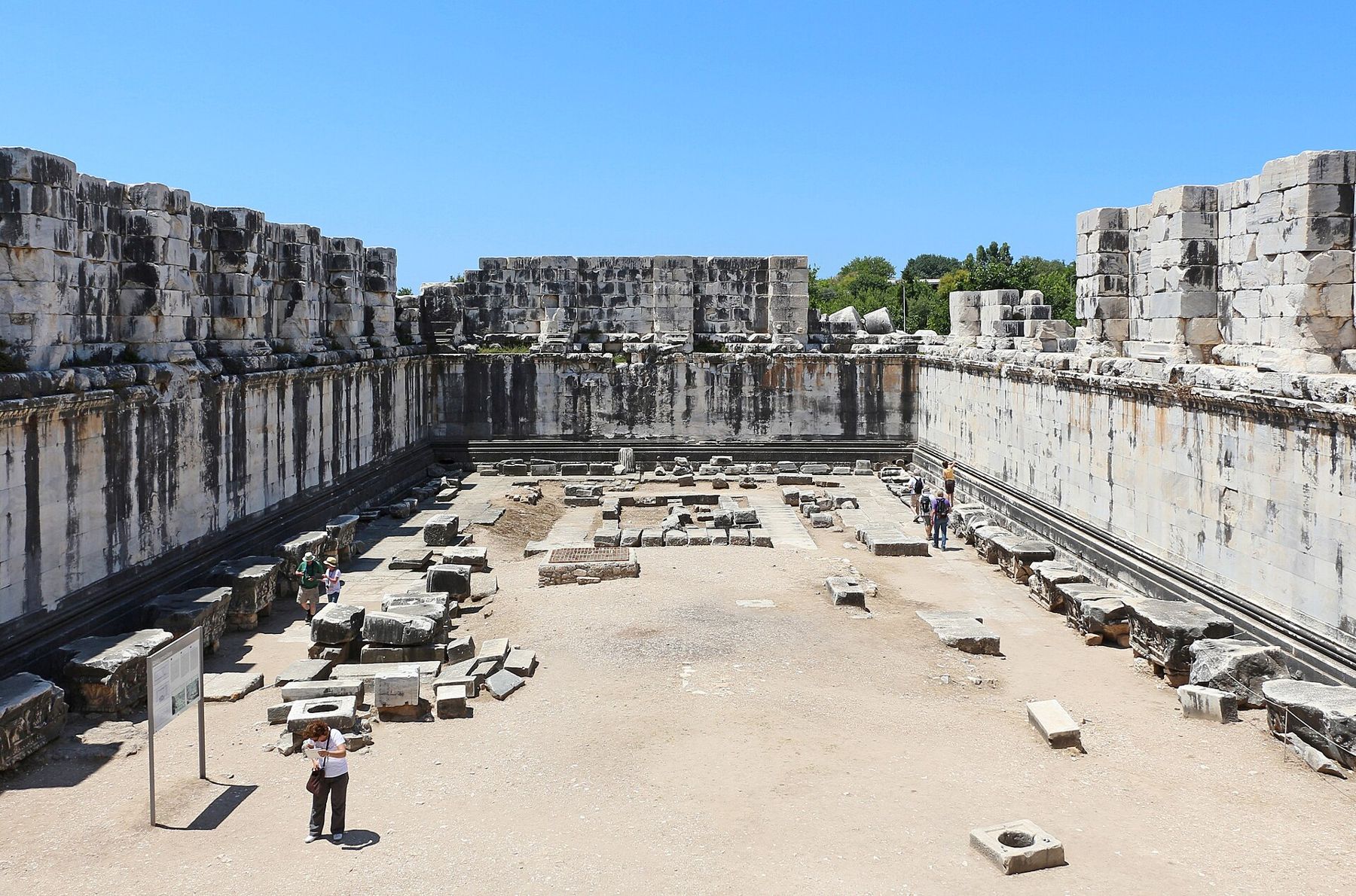
Look closely at the walls of the court. Faint lines scratched into the stone, discovered in the late 1970s, turned out to be full-size working drawings left by the builders: the profiles of columns and mouldings laid out so masons could copy them. They are hard to spot without good light and a sharp eye, but knowing they are there makes the walls feel like a workshop.
2ND C. ADALSO ON THE INDEXMiletus, a harbour city stranded in fields
The Medusa head and the sacred way
Near the temple's entrance lies a large carved head of Medusa, part of a frieze that once ran around the building, with snakes knotted under her chin. It has become the symbol of the site and draws a small crowd for photographs. Other fragments of the frieze, carved with leaves and mythical creatures, lie along the edge of the platform.
The sacred way from Miletus ended at Didyma. Processions walked it at festivals, past statues of seated figures, lions and sphinxes. A short excavated stretch can be seen near the temple, but most of the statues that lined it are in museums abroad. To follow the old link, visit Miletus on the same day; the theatre and the baths there make a good contrast with this single great building.
Didim and the coast
Didim, once called Yenihisar, grew around the temple and is now a lively resort, especially at Altınkum beach a few kilometres south, where much of the town's summer life happens. The temple itself is a short walk from the main road. Arriving by bus, ask for the stop for the temple, Apollon Tapınağı, rather than the beach.
The site has little shade, and its pale stone reflects the sun. Mornings and late afternoons are best, and in high summer the late afternoon light on the columns is the finest time of the day. Opening hours and ticket arrangements change with the season.
Didyma in a longer day
Didyma is the southern end of a classic day that also takes in Priene and Miletus. Without a car, public transport between the three is patchy: minibuses connect each of them with Söke, but not always with each other. A hired car or a taxi for the day from Söke or Kuşadası makes it simple. With public transport, aim for Didyma and one other site, and save the third for another day.
In Didim itself there is little else of the ancient sanctuary to see, but the streets around the temple keep a few old stone houses from the time when Greek families lived here, before the population exchange of the 1920s. The modern town makes a good lunch stop between the sites.
If you only see one of the three, choose by what you like. Priene has the most beautiful setting, Miletus the most atmosphere, and Didyma the most astonishing single building. All three together show how the Ionian cities lived, governed and worshipped, and how much the sea and the river decided their fate.