THE RUIN INDEX · MILETUS · BALAT
Miletus, a harbour city stranded in fields
Once a great port with four harbours, Miletus now sits miles from the sea among cotton fields. Its theatre still rises like a cliff, and spring floods turn the lower town into a marsh full of frogs.
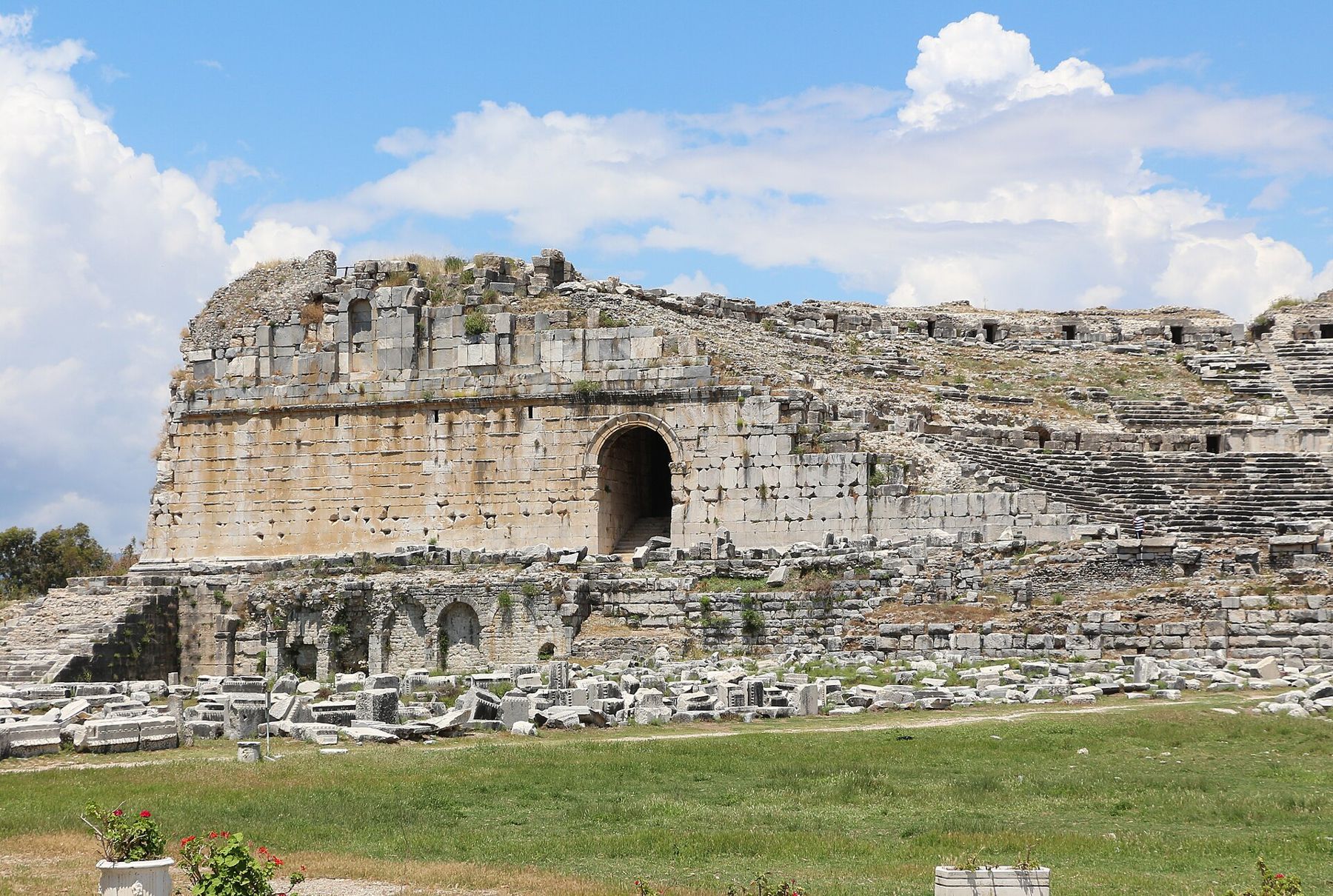
Miletus was one of the great cities of the Greek world. It sent out colonies around the Black Sea, gave its name to the first school of Greek philosophy, with Thales, Anaximander and Anaximenes, and was famous for its harbours. Today the ruins lie near the village of Balat in Aydın province, a long way from any water. The Büyük Menderes, the ancient Maeander, carried so much silt over the centuries that the coast moved west and left the city stranded in the middle of a plain.
Philosophers and colonists
In the 7th and 6th centuries BC Miletus was the leading city of Ionia. Its traders and settlers founded dozens of colonies around the Black Sea and beyond, and its thinkers began asking what the world was made of without reaching first for the gods. Thales is said to have predicted an eclipse; Anaximander drew one of the first maps of the known world. None of their houses survive, but it helps to know, standing in the fields, that this was where Greek science and philosophy took their first steps.
A city on a grid
The Persians destroyed Miletus in 494 BC after the Ionian Revolt. When it was rebuilt, it was laid out on a regular grid of streets, a plan associated with Hippodamus of Miletus, whose name has stuck to grid planning ever since. Much of what stands today is later, from the Hellenistic and especially the Roman period, when the city was rebuilt again in marble, but the principle of straight streets and planned public spaces runs through the site.
The theatre that looks like a fortress
The first thing you see from the road is the great theatre, its outer wall rising high above the fields. It began as a Hellenistic theatre and was greatly enlarged in the Roman period, when it held perhaps fifteen thousand people. Climb to the upper rows for the view: on a clear day you can trace the old harbour basin, now grass and reeds, and the line of the ancient shore. In the Byzantine era a small castle was built on top of the theatre, and parts of it still crown the hill.
From the top of the theatre you also see how small the Byzantine and later village was compared with the ancient city, which spread across the whole peninsula below you to the harbours on either side.
Look for inscriptions on the seats. Some reserved places for particular groups, a reminder that ancient audiences were not seated at random.
The Baths of Faustina
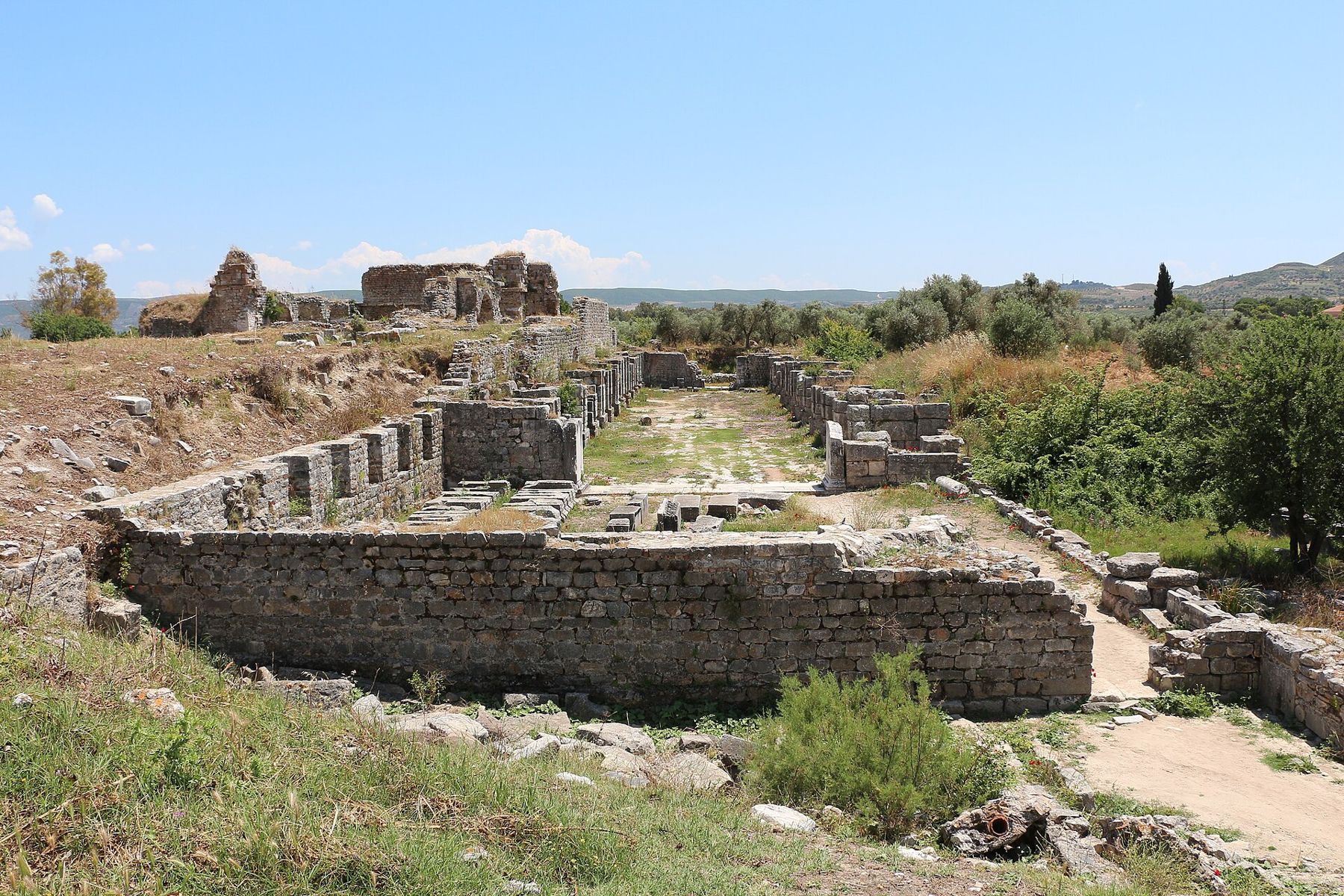
South of the theatre, the Baths of Faustina are the best-preserved building in the lower city. They were built in the 2nd century AD and named for Faustina the Younger, wife of the emperor Marcus Aurelius. You can still walk through the sequence of rooms, from the cold to the hot, and see the vaulted brick halls where hot air ran under raised floors. A reclining river god that once fed one of the pools now sits nearby in the shade of the walls.
4TH C. BCALSO ON THE INDEXPriene, a town laid out on a grid
Between the theatre and the baths lie the foundations of the Lion Harbour, which took its name from two stone lions that guarded its mouth. The lions are still there, half sunk in the ground. Nearby are the remains of a harbour monument, a stoa and the market gate whose marble facade was taken to Berlin in the early 20th century and rebuilt in the Pergamon Museum.
The mosque among the ruins
At the southern edge of the site stands the İlyas Bey Mosque, built in 1404 by a ruler of the Menteşe beylik, one of the Turkish principalities that held this coast before the Ottomans. Its marble walls and carved window frames reuse stone from the ancient city, and its proportions are simple and fine. Storks often nest on the buildings nearby. It is a short walk from the baths and easy to overlook if you leave from the theatre.
Mud, frogs and the best season
The low parts of Miletus flood after winter rain, and in spring the agora and harbour areas can be marsh, loud with frogs and full of birds. It is beautiful, but some paths will be under water, so wear shoes you do not mind getting muddy and keep to the higher routes around the theatre. By early summer the ground dries out and the heat arrives; there is very little shade beyond the walls of the baths.
One day, three Ionian cities
Miletus is the middle stop of a classic day that also takes in Priene to the north and the temple at Didyma to the south. Public transport between them is thin, so a hired car or a taxi from Söke or Didim makes the day far easier. The small museum near the site entrance is worth half an hour for its finds and models. Opening hours and ticket arrangements vary with the season.
A sacred way about twenty kilometres long once linked Miletus with the oracle of Apollo at Didyma, which the city controlled. Processions walked it for festivals, past statues of seated figures and lions, several of which ended up in the British Museum. Little of the road survives, but the link explains why the two sites belong together on the same day.
Start with the theatre while the light is low, then the harbour and the baths, and finish at the mosque, where you can sit in the shade of the porch before the drive on.